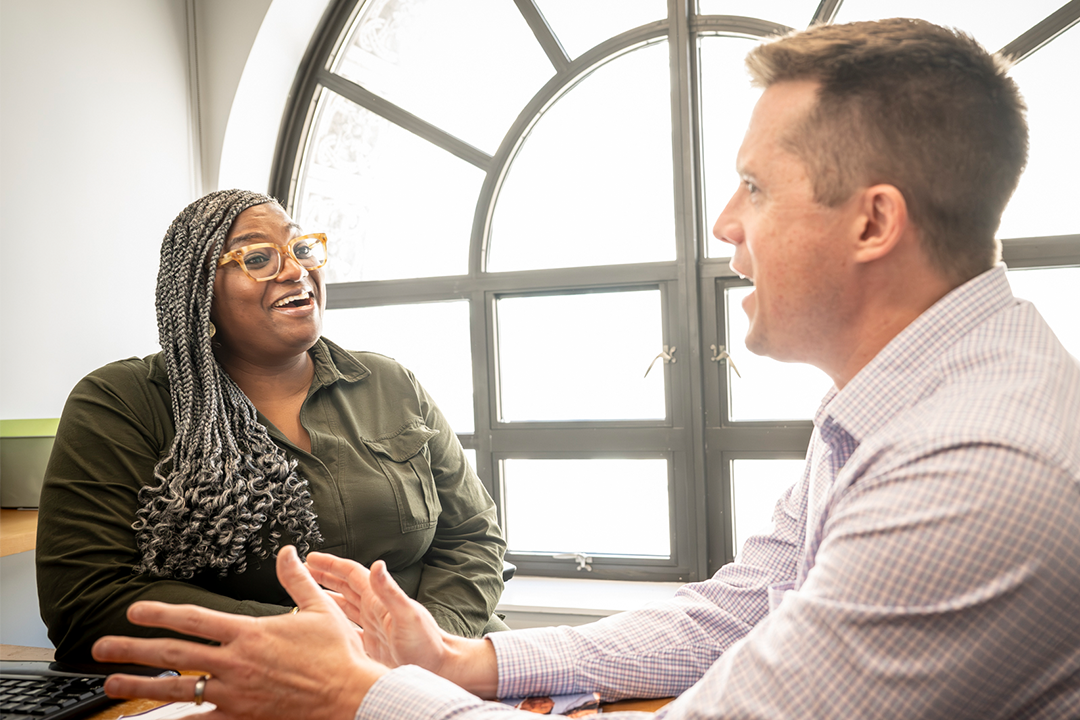
Can a group of strangers, scattered across different schools and logging in from their living rooms, become an indispensable support system for one another? For residents in the NYU Teacher Residency, the answer arrives faster than most expect.
The program’s Master of Arts in Teaching is built around a cohort model: residents move through coursework together, meet twice a week online with faculty and peers, and lean on a web of mentors even as they spend their days in residency in separate classrooms and, often, separate cities. That structure is not incidental to the experience. It is, by design, one of the primary mechanisms by which the program prepares new teachers for the classroom.
Build Lifelong Connections in Our MAT Residency
Experience Group Learning Designed for Impact
A Cohort That Feels Like Home
Many residents begin the program uncertain about what an online cohort can offer. Candy Zheng was one of them.
“Honestly, when I started the program, I was a little hesitant because it was all online, and I felt like I was losing out on that interpersonal connection with friends in the same cohort,” Zheng says. That hesitation didn’t last. “Genuinely meeting those people that first day on Zoom felt like seeing family again. It was very familiar, because we were all going through very similar experiences, and we were able to bond over that.”
The relationships built in that first Zoom session carried her through the year. “I don’t think I would have been able to do this program without them,” she says. Zheng’s home group, five residents who checked in almost daily, became a running source of support: “It’s really fun just to hear their experiences and their stories and just bond over that.”
Linwood Brown had a similar experience. “What surprised me about this residency is the community,” he says. “I’ve made some of the best friends, ones that I’ll probably keep forever. We’re all in the same boat. We’re stressed out all the time, so we get it.”
Faculty member Tamara Sewell has watched this pattern repeat for a decade. Residents are consistently surprised, she says, by how strong a relationship can grow with people they’ve never met in person, and by how “they get to know the ins and outs of each other’s personal lives over Zoom. We’re in people’s homes; we see the toddler crawling in the background, we say hello to the child. Instead of ‘online program,’ I prefer the term ‘virtual program,’ because we’re using virtual tools, but we are live, in person, and creating spaces where people feel safe to be their whole, authentic selves.”
Collaboration Is Part of the Learning Experience
Community in the residency isn’t confined to informal friendships. It’s built into how the coursework itself works.
Ayad Muhammad, comparing the residency to his prior college experience, describes a program that runs on shared problem-solving rather than lectures. “I think I have never been part of a college class where I’ve been as involved and as collaborative with other people as I am here,” he says. “For each of our classes, we are basically given a prompt, and we work together to figure it out. It’s not lecture-driven; it’s collaboration-driven. It is group learning.”
That collaboration extends into each resident’s chosen content area as well. Residents pursuing a Secondary Education degree focus on a specific subject—English, mathematics, science, or social studies—and work alongside a content mentor and a cohort of peers studying the same subject. For Jacqueline Kahn, who focused on mathematics, that meant a built-in group of peers facing the same day-to-day questions.
“Within my content area of mathematics, I would say that we definitely did have a lot of interaction among our peers, whether it was within the weekly classes, or even just outside of class where we communicate and talk about our day,” Kahn says. “We would bounce ideas off of each other. It was really cool to have that kind of support system.”
Supported by Faculty Every Step of the Way
Every resident benefits from a comprehensive support system: a school teaching mentor, a dedicated content mentor in their subject area, a residency director, and NYU Steinhardt module faculty. According to Clinical Associate Professor Frank Pignatosi, that layered support is intentional: unlike many residency models, which leave coaching primarily to the school-based mentor, the NYU program has faculty step directly into the coaching role alongside the classroom mentor. Three of a resident’s four mentors, Pignatosi notes, work with that resident every week for the entire year.
Resident Sam Adels, reflecting on that support, credits both faculty and peers. “You definitely can’t do it without the support of the professors,” Adels says. “They teach you amazing things, and they’re also just there to support you, to give you guidance.” Adels singles out one faculty member for her availability: “If there’s any issues or any problems, if you need to troubleshoot anything, she’s always there to help. Very available.”
Peers matter just as much, Adels adds. “We have each other’s backs to lean on, cry on, complain on, and just support each other. My cohort has been fantastic.”
Growing Together Through Community
For some residents, the cohort model builds more than academic support. It builds confidence to speak up.
Sewell describes a group of residents working at schools in the Bronx who felt they were being moved between classrooms without a chance to build relationships with students. Rather than raise the issue individually, the four residents approached their principal together. “They found their collective voice, rather than thinking that they were in this on their own,” Sewell says. The group now meets weekly with the principal, a channel they’ve since used to advocate for their students as well.
Sohibahon Shakirova describes a similar dynamic within her own cohort. “The group that I was with, they were so understanding, so supportive, so creative,” she says. “The classes that we attend together, the activities that we did together, the projects that we create together just brought out all the potential that was sleeping deep in me.” She credits the program’s structure for surfacing strengths residents didn’t know they had: “I appreciate how they were able to create this structure that reveals strengths people weren’t even aware they had.”
Community That Lasts Beyond Graduation
Residents often start the NYU Master of Arts in Teaching Teacher Residency program expecting a solitary online experience. Most leave with something closer to a professional network and a group of people who understand exactly what the year demanded of them.
Sewell sums up what she hears from residents year after year. The work is intense, and there are moments when a resident feels like giving up. “But the great thing about having these cohorts is everybody else comes together and says, ‘This is your moment to feel like you can’t do this, but we’re not going to let you fail,'” she says. “And that’s not just their faculty, it’s their colleagues as well.”
For prospective residents weighing whether an online program can deliver real relationships, that’s the case the current cohort makes best: the classrooms may be separate, but the residents rarely are.