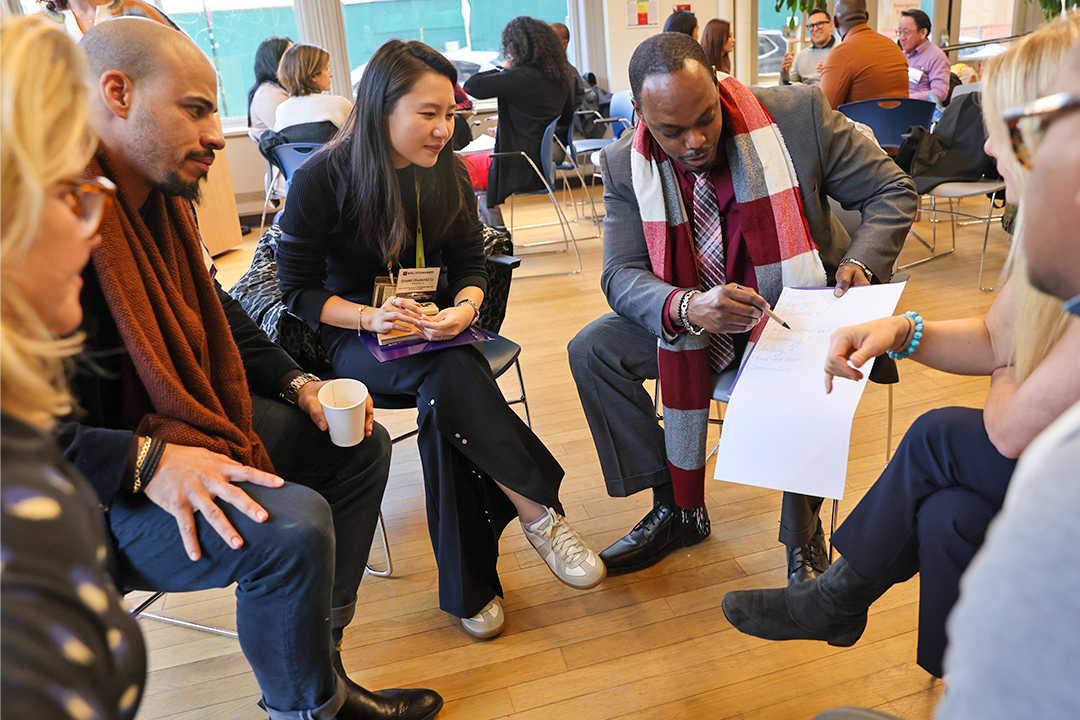
Ask a room full of teachers how they found their way to their profession, and you will rarely hear the same story twice. For every educator who spent childhood arranging stuffed animals into a makeshift classroom, there is another who arrived by a winding detour—through corporate finance offices, theater stages, or years spent in careers that never quite fit. At the NYU Teacher Residency, those detours aren’t viewed as lost time; they are considered a competitive edge.
The program’s accelerated one-year model intentionally pairs a Master of Arts in Teaching with immediate, full-time classroom immersion in partner schools. By design, it treats a candidate’s past professional life not as baggage to discard, but as vital scaffolding for their new career. From former actors to corporate analysts, these residents are proving that the skills forged in entirely different industries are often exactly what modern classrooms need most—and their journeys reveal just how much is gained when teachers bring their whole histories into the classroom.
Earn Your MAT in Just One Year at NYU
Change Careers and Make an Impact in the Classroom
There’s No One Path to Becoming a Great Teacher
The cohort at the NYU Teacher Residency spans nearly every stage of adult life: recent college graduates, parents, mid-career professionals, and veterans of corporate America. While their individual turning points vary, they are united by a shared desire to do work that directly impacts the world and helps students who have historically faced systemic barriers succeed.
For Ayad Muhammad, that realization came while staring at spreadsheets. After majoring in economics, he found himself climbing the corporate ladder in finance, managing assets and conducting market research. But the corporate view soon lost its luster. “Frankly, I found a lot of the work that I was doing boring,” Muhammad says. “I felt like I wasn’t seeing the product of my work. I wasn’t really involved in the outcome.”
Trading the detachment of asset management for the immediate, high-stakes environment of a classroom changed everything. “Teaching offered the opposite,” he says. “I felt like this was something that really resonated with me—being involved in the community and actually making a difference.”
Linwood Brown made a similarly dramatic leap, trading the silver screen for the schoolhouse. While a career in acting provided its own creative fulfillment, it was his perspective as a parent that ultimately shifted his trajectory. “I have a daughter who is in the third grade, and I was concerned about the state of education,” Brown says. Watching her experience unfold in real-time sparked a desire to step off the stage and directly into the system, motivating him to join the residency and shape the kind of classroom he wanted to see in the world.
Your Previous Experience Doesn’t Stay Behind
This diverse mix of professional histories means that entering the classroom doesn’t require wiping the slate clean. Instead, residents carry forward the professional judgment, distinct skill sets, and personal narratives forged in their previous lives—assets that hold substantial weight in a school setting.
Andrew Torres, a clinical assistant professor and residency director in the NYU Teacher Residency, watches this translation happen across the entire cohort, regardless of where candidates start. “Whether it be the career changer or the recent undergraduate, they all start to see the value of working in these communities,” Torres says. He notes that the program explicitly rejects the traditional, patronizing tropes of urban education. “It’s not about a savior model… It’s about bringing a unique value to their lived experience that simply can’t be recreated.”
That value often takes the form of global and specialized expertise. Resident Sohibahon Shakirova, for instance, arrived at the program with an international perspective and seven years of private school teaching experience already under her belt. Rather than leaving that background behind, she used the residency to adapt and ground her seasoned approach within the unique, fast-paced environment of New York City’s public schools.
Learning to Teach Is Also Learning About Yourself
The residency year transforms how participants see themselves. For Shakirova, it meant moving from uncertainty to total alignment: “I found myself in teaching, and I’m 100% sure this is the career I want.”
For Jacqueline Kahn, who previously taught SAT and ACT prep, purpose came from breaking down barriers for students who traditionally struggled with math. Hearing a student say, “This is the first time I actually feel like I’m learning math,” validated Kahn’s original goal: “In high school, I felt like I had really negative experiences with math teachers. I wanted to be the math teacher that I never had.”
Supporting Career Changers From Day One
To meet incoming educators at varying stages of readiness, the NYU Teacher Residency engineered a model that meets candidates precisely where they are—including those who have never stood in front of a classroom. Residents train side by side with experienced mentor teachers, absorbing classroom management and pedagogy through a “gradual release of responsibility.” Rather than being thrown into the deep end, candidates take on leading roles in increments as their time in placement expands, while concurrent graduate coursework reinforces those daily real-time lessons.
Even with that safety net, the learning curve can be steep. Andrew Torres has watched the same mid-year turning point play out year after year. Somewhere around late fall, he notes, most residents hit what he describes as a “brick wall”—a moment when the sheer reality and exhaustion of teaching sink in simultaneously.
“Residents will hit a wall and think, ‘Oh, I didn’t see that coming,’” Torres says. To keep that moment from derailing a career before it starts, he prepares them for the inevitable friction early on. “I want them to believe in themselves beyond those moments in the school where you’re naturally going to doubt yourself.”
For career changers, that mid-year wall often serves as a powerful catalyst for growth. Annaly Babb-Guerra, co-director of the residency, recalls two mature residents who entered the program anxious about their ability to connect across generational lines. Both relied heavily on their deep subject expertise, assuming domain knowledge alone would win over their students.
“By the end of the year, they realized lecturing isn’t how you get students to buy into what you’re teaching,” Babb-Guerra says. “Connections with students matter most of all.”
That deliberate scaffolding is precisely what allows career changers to make such profound mindset shifts without burning out. Stacie Brensilver Berman, a residency director and social studies content mentor, emphasizes that the program’s high-touch design is intentionally calibrated for newcomers.
“It’s designed for somebody who is passionate about teaching but knows that they need the support that the program will provide because they’ve never taught before, because they’re changing careers, because education is something totally new to them,” Berman says. “They know that they need to start at the ground floor and work their way up to understand what this teaching thing is and how do I do it in a way that some other programs might not provide them.”
Building a Teaching Workforce That Reflects Its Communities
Beyond diversifying professional backgrounds, the NYU Teacher Residency program‘s non-traditional pipeline helps reshape the demographic makeup of American classrooms. Nationwide, roughly 20 percent of public school teachers identify as people of color, according to the National Center for Education Statistics. At the NYU Teacher Residency, that figure soars: more than 66 percent of residents identify as Black, Indigenous, or people of color.
That shift is anything but accidental.
“One of our core missions is to directly impact the demographics of our nation’s teaching force,” says Frank Pignatosi, vice chair of the Department of Teaching and Learning and clinical associate professor of the residency. By opening doors to candidates outside the traditional undergraduate education major, the program consistently yields cohorts that are 60 to 70 percent teachers of color.
To achieve that level of representation, the program actively breaks down barriers to higher education, reaching out to non-traditional applicants who might never have pictured themselves in a master’s program.
“We make a concerted effort to recruit people who may have never considered graduate school before,” says Stacie Brensilver Berman. “One of our goals is to make sure that schools that we’re working with, which have majority Black and Brown students, that those students have teachers who look like them.”
Exceptional teachers rarely share a single origin story. They come from trading floors, soundstages, tutoring centers, and corporate desks. What unites them at the NYU Teacher Residency is a rigorous year of co-teaching, tailored academic work, and a commitment to showing up fully for their students. For those ready to turn a previous career into a powerful second act, the classroom isn’t just a career change—it’s where a lifetime of experience finally finds its purpose.